Menu

The National Portrait Gallery acknowledges the Traditional Custodians of Country throughout Australia and recognises the continuing connection to lands, waters and communities. We pay our respect to Aboriginal and Torres Strait Islander cultures and to Elders both past and present.

Aboriginal and Torres Strait Islander viewers are warned that this website contains images of deceased persons.

Portrait Artist of the Year

by Rachel Hopkins, 2 December 2025

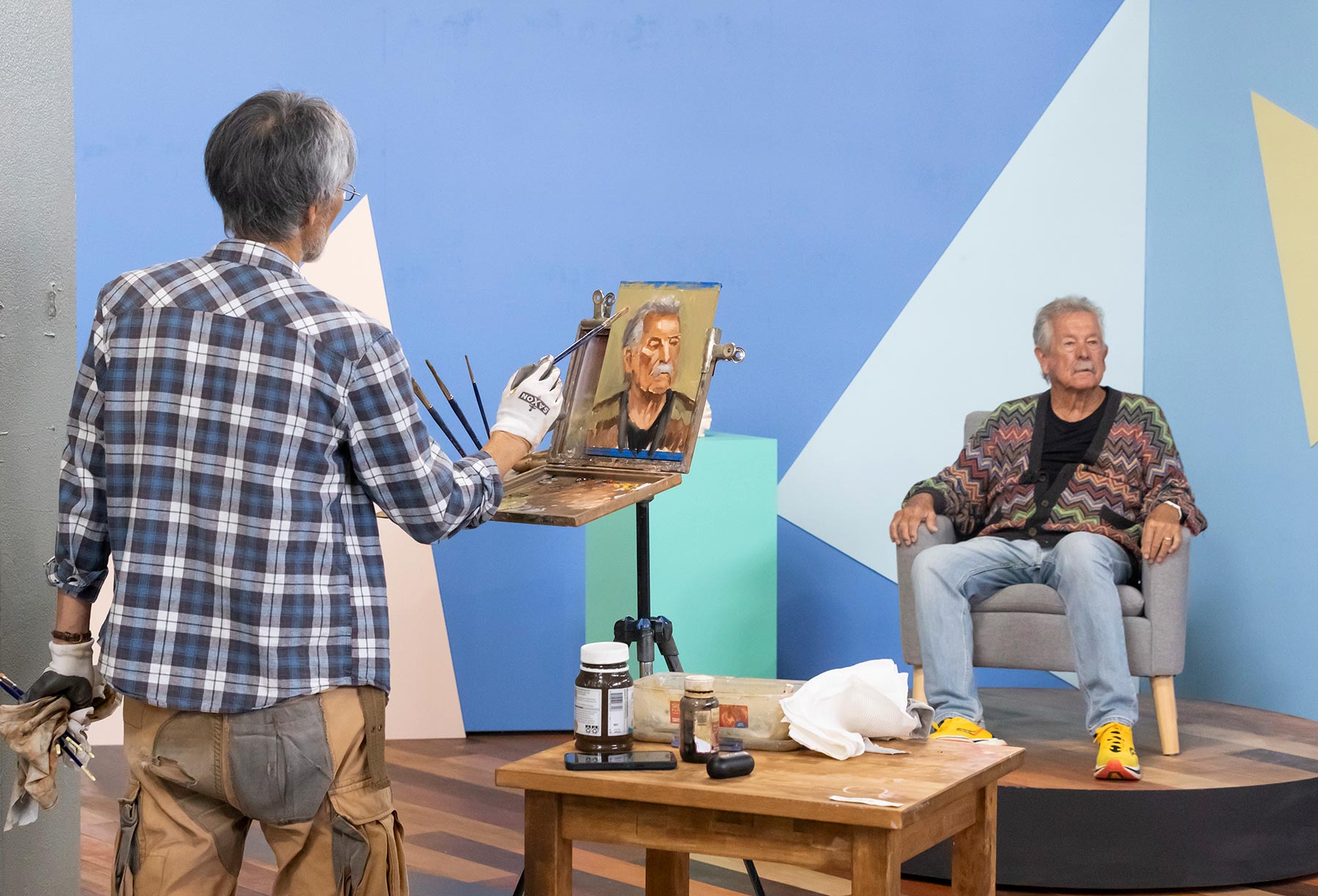
Behind-the-scenes photographs of the Portrait Artist of the Year filming, including the judges Abdul Abdullah, Bree Pickering and Robert Wellington, celebrity sitters Tsehay Hawkins, Maggie Beer, Madison de Rozario, Costa Georgiadis and Ken Done, co-host Miranda Tapsell and artists. Images courtesy of the ABC.

Nine artists wait nervously by their easels, blank canvases, paint, charcoal and watercolours at the ready. In armchairs in front of them sit three familiar Australian faces – cook, restaurateur and media personality Maggie Beer AO, dancer, singer and Yellow Wiggle Tsehay Hawkins and renowned artist Ken Done AM. The artists – amateur, emerging and professional – hail from across the country and have diverse creative backgrounds. From talented hobbyists, high school art teachers and tattoo artists to live wedding painters and those with a well-established practice, they have four short hours to complete a portrait of a sitter they have only just met. This is heat one, and they are all vying to become Australia’s first Portrait Artist of the Year.

First airing in the UK in 2013, the television series Portrait Artist of the Year has soared in popularity over its 11 seasons, springboarding careers, inspiring spinoffs and entertaining and educating millions of Britons about the art of portraiture. The show unearths artistic talent from around the country, and across six heats, a semi-final and final, artists test their skills to paint portraits of a range of well-known sitters. Judged by an expert panel, the winner receives the opportunity to complete a prestigious final commission for a major gallery.

Portrait Artist of the Year invites viewers to learn about one of the oldest and most universal art forms in an easy to digest format, and provides a portal into the art world that can sometimes feel elitist and intimidating. Its enduring popularity is aided by the cast of high-profile celebrity sitters – the UK version has featured conservationist Dr Jane Goodall, actors Judi Dench and Ian McKellen, Spice Girl Emma Bunton and comedian Lenny Henry – but at its heart, this is a series about nurturing and celebrating creativity.

The new ABC version of the show is hosted by comedian and writer Luke McGregor and Larrakia actor Miranda Tapsell. They are joined by three expert judges: National Portrait Gallery Director Bree Pickering, award-winning multidisciplinary artist Abdul Abdullah, and Associate Professor of Art History at the Australian National University Robert Wellington. Their considered, kind approach – and complete lack of art pretension – encourages a broad audience to engage with portraiture while also allowing art aficionados to learn about its nuances.

Back on set at the White Bay Power Station in Sydney, the judges are getting miked up by audio tech Jye. The live audience – including friends and family of the artists – wait patiently, not quite knowing what to expect from the next four hours. McGregor chats casually, deftly delivering one-liners to artists and sitters while producers bustle and cameras are set. A few moments of silence, and then the four-hour countdown begins and the artists spring into action. Some beeline to the sitter to take quick photos, coaxing them into various poses, others start conversations, asking the sitters about the personal objects they’ve brought in. Maggie Beer’s 35-year-old copper egg whisking bowl speaks to finding the right tool at the right time, while Ethiopia-born Tsehay Hawkins holds a homemade book about her adoption story.

Each of the heats rolls out in a similar fashion – a palpable sense of urgency, but also a deep level of respect and camaraderie at the shared challenge, each artist making way for the others. But the four-hour time limit is not the only pressure point. Between the curious live audience watching on, a cavalcade of cameras, producers interrupting to ask about technique, hosts and sitters cracking jokes and hovering judges, it is far from the calm environment of an artist studio. Some artists thrive on the atmosphere and excitement at the mere presence of their famous sitters, others stay deep in concentration with noise-cancelling headphones. Judge Robert Wellington describes watching them as ‘like learning a magic trick … audiences will love getting a peek behind the scenes of how artists work’. Abdullah agrees. ‘I think audiences will experience a really revealing insight into the artmaking process, and I think it will demystify things for people.’

When brushes were laid down and it came to the judging process, the three experts each brought their own perspective. ‘A great portrait of a celebrated or well-known person must feel familiar but also unexpected,’ Pickering says. ‘I think we were all looking for the magic that happens when an artist really sees a sitter and is then bold enough to share their insight with us through their artwork. The time pressure meant artists had to trust their instincts.’ With so many different styles, techniques and materials used, Wellington was ‘looking for those who excelled in their own particular way – those who made a great example of its kind within the constraints of the four-hour sitting’. And despite his insights into the various technical abilities on display, it was not about pure skill for Abdullah, who wanted to see ‘portraits that communicated something unique about the sitter that you wouldn’t necessarily get from a photo’. More than mere likeness, who was able to capture a bit of someone’s essence and connect the viewer to their story?

Ultimately, the judges agreed on a top three, then narrowed it down to one artist to go through to the next stage. The overall winner will paint a final commission to be hung at the National Portrait Gallery in Canberra. Naturally there’s some disappointment from those who don’t make it through, but, like much of the show, the overwhelming sentiment is encouragement. Of course, armchair and actual experts alike will have favourites, debate the merits of each portrait and may disagree with the judges. In the end, creativity is the real winner here. Much like the National Portrait Gallery, this series plays an important role in providing an accessible way for people across Australia to engage with art and culture.

Reflecting on the show, Pickering says it demonstrates how central creativity is to our experience of being human. ‘It’s how we communicate and come together. Creativity is for everyone and about everyone. Portrait Artist of the Year is a celebration of that.’ 

© National Portrait Gallery 2026
King Edward Terrace, Parkes
Canberra, ACT 2600, Australia

Phone +61 2 6102 7000
ABN: 54 74 277 1196

The National Portrait Gallery acknowledges the Traditional Custodians of Country throughout Australia and recognises the continuing connection to lands, waters and communities. We pay our respect to Aboriginal and Torres Strait Islander cultures and to Elders past and present. We respectfully advise that this site includes works by, images of, names of, voices of and references to deceased people.

This website comprises and contains copyrighted materials and works. Copyright in all materials and/or works comprising or contained within this website remains with the National Portrait Gallery and other copyright owners as specified.

The National Portrait Gallery respects the artistic and intellectual property rights of others. The use of images of works of art reproduced on this website and all other content may be restricted under the Australian Copyright Act 1968 (Cth). Requests for a reproduction of a work of art or other content can be made through a Reproduction request. For further information please contact NPG Copyright.

The National Portrait Gallery is an Australian Government Agency