Menu

The National Portrait Gallery acknowledges the Traditional Custodians of Country throughout Australia and recognises the continuing connection to lands, waters and communities. We pay our respect to Aboriginal and Torres Strait Islander cultures and to Elders both past and present.

Aboriginal and Torres Strait Islander viewers are warned that this website contains images of deceased persons.

Shared affinities

by Dr Emma Kindred and Isobel Parker Philip, 2 December 2025

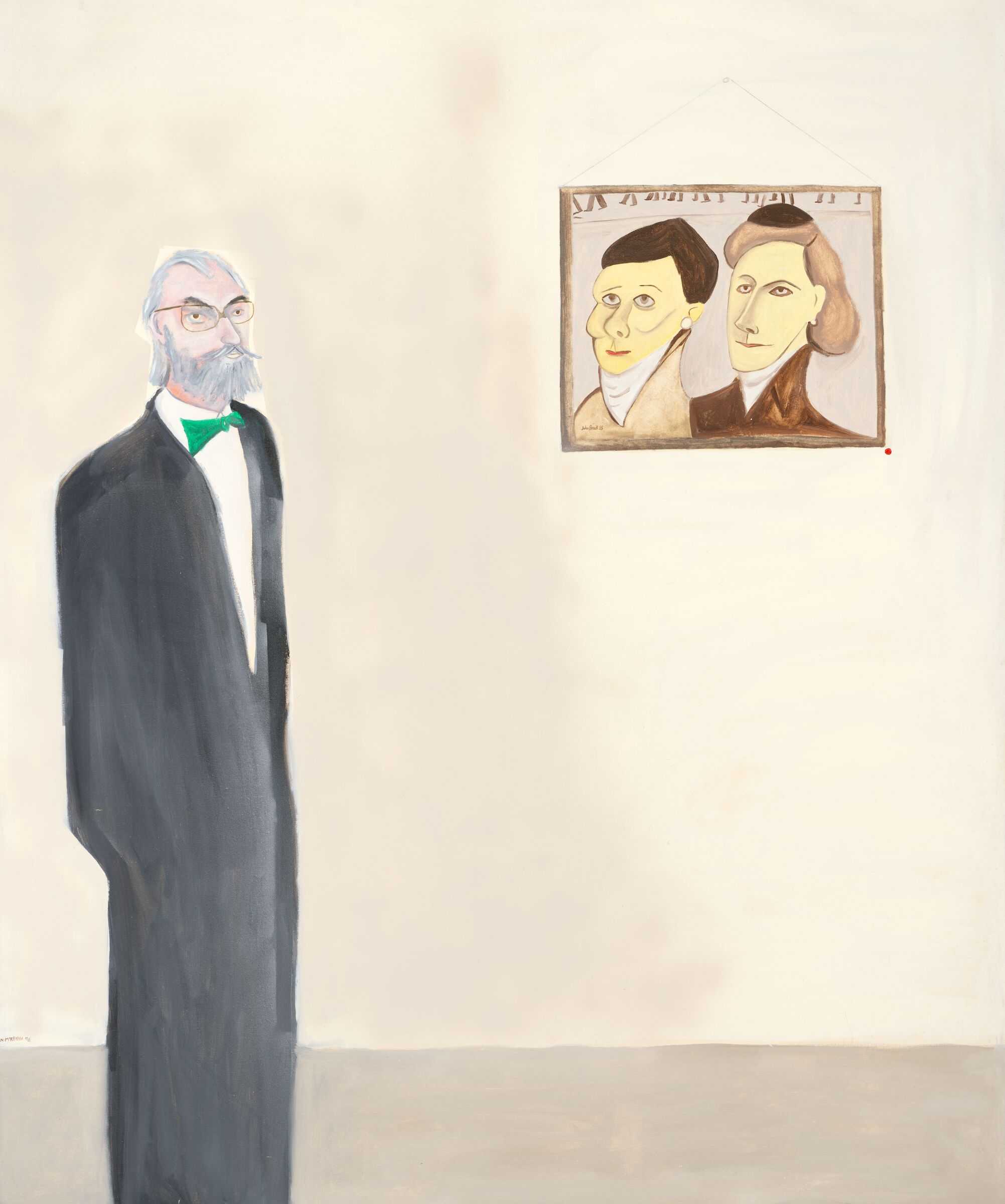
Dr Joseph Brown with Two Typists, 1996 Noel McKenna. © Noel McKenna/Copyright Agency, 2024. John Brack 'Two Typists' 1955 is kindly reproduced with permission from Helen Brack

When crafting a show that places two artists in dialogue, we map connections, looking for points of contact and kinship. It is not often such tracing leads to an oversized crossword puzzle in the blocky shape of Australia. In Noel McKenna’s 2004 work Australian Art History 1933–1978, he set out clues across and down for the names of artists, critics, gallery directors and art dealers. 35 across reads: ‘Artist. Born 1920 Melbourne. September 11, 1952, gave lecture on Seurat at N.G.V. Exhibition of racecourse series of prints + watercolours in 1956.’ The five-letter answer? BRACK. But then again, McKenna has long been leaving clues that trace back to John Brack.

Despite them working almost half a century apart, clear aesthetic and thematic lineages can be mapped between the work of Brack and McKenna. The National Portrait Gallery’s exhibition John Brack x Noel McKenna brings their work together to tease out these affinities. The exhibition presents new ways of thinking about each artists’ work, specifically their approaches to portraiture, and the echoes that have long reverberated between them.

Both artists draw on the texture of modern life as subject, offering a social commentary at times satirical, to the tipping point of the surreal, yet always tempered by sympathy and compassion. Concerned with the interior and interiority, they have each pursued a portraiture practice that is nuanced and emotionally astute, carrying tenderness that cuts through with wry humour. More explicit echoes slyly emerge the longer you look: the personalities of the racetrack, figures in sparsely furnished and tilting interiors, unremarkable suburban landscapes, and a shared tendency towards compositional flatness. There is a quiet tension in these works, with moments held, suspended, an intake of breath between bouts of activity. Neither artist bends to a fashion or movement, largely painting outside the expectations of the art market or the slow parade of artistic isms. But even as they buck trends, they’ve created a consonance that spans decades: a repartee, a tête-à-tête.

Even more convincing than the crossword, McKenna leaves a big clue to the legacy of Brack in his 1996 painting Dr Joseph Brown with Two Typists from the National Portrait Gallery’s collection. In this portrait, the art dealer and philanthropist Joseph Brown AO OBE lingers on the left-hand side of the composition. He faces a painting that hangs slightly askew, with a red ‘sold’ sticker beneath it. The work in question is Brack’s Two Typists (1955), a study for his famed Collins St., 5 pm. This picture within a picture, a direct citation of Brack, gives McKenna’s subject something to play against. Brown looks towards the two stern women from Brack’s work, their eyelines almost aligning.

Standing in a gallery, Brown assumes the hand-in-pocket pose and lean verticality of the male figure in another Brack work, The new house (1953), in which the artist had also included a ‘picture within a picture’. Here, Brack’s Menzies-era suburban homeowners are positioned to the side of a modestly framed reproduction of Vincent van Gogh’s The Langlois Bridge (1888). This is an art-historical call-and-response of sorts, with McKenna collapsing these two well-known paintings by Brack into Brown’s white-walled workspace. Dr Joseph Brown with Two Typists is a portrait that encapsulates the exhibition in its entirety. But it is more complex an entanglement than a single canvas.

Having left school at 16, Melbourne-born Brack enrolled in evening drawing classes at the National Gallery of Victoria and later went on to full-time studies under renowned portraitist William Dargie. When Brack opened his 1953 solo exhibition at Peter Bray Gallery in Melbourne, the critic for The Port Philip Gazette wrote ‘Here at last ... a painter aware of the life around him and recreating it with humour, sensitivity and compassion’.

McKenna shares this jocular, yet perceptive sensibility. He grew up in Brisbane, where he studied architecture before transferring to art school, first at Brisbane College of Art and then Sydney’s Alexander Mackie College. In contrast to Brack’s early critical acclaim, McKenna has said he was initially considered unfashionable, but he gradually developed a dedicated following for his spare, linear style and restrained renderings of seemingly ordinary, day-to-day scenes. McKenna became fascinated with Brack after seeing his 1957 work Nude with two chairs at the Art Gallery of New South Wales in 1981. ‘I was taken by the almost fluorescent green-yellow of the figure,’ he says. ‘At the time I used to have a stall at Balmain markets selling postcards. I drew a coloured pencil drawing of his nude work and made a postcard of it.’

McKenna’s attention to the emotional weight of the objects and spaces surrounding his figures keenly shapes our reading of them; as in many of Brack’s works, including Nude with two chairs, for McKenna, the mise en scène is as important as the person. In McKenna’s artist statement for Domestic interior, a finalist work in the 2014 Sulman Prize, he described his paintings of interiors as representative of people: ‘People’s homes, the way they decorate them, arrange furniture and their knick-knacks, the amount of time spent inside them, all say a lot about people in general.’ In Quiet room (2013), McKenna locates himself within that domestic space, seated in his grandfather’s upholstered armchair reading David Sylvester’s Interviews with American artists. A painting of a house by Australian artist Max Watters hangs to the left of a closed door, while stretched out across the carpet before the fireplace is McKenna’s first greyhound, also called Max. In partial disagreement with the geometry of the low-ceilinged interior, an open bookshelf reveals a catalogue of influence: artists Anne Dangar and Lucian Freud, David Moore, Colin McCahon, and multiple volumes on Paul Klee – an early favourite for McKenna. And there is, of course, Brack.
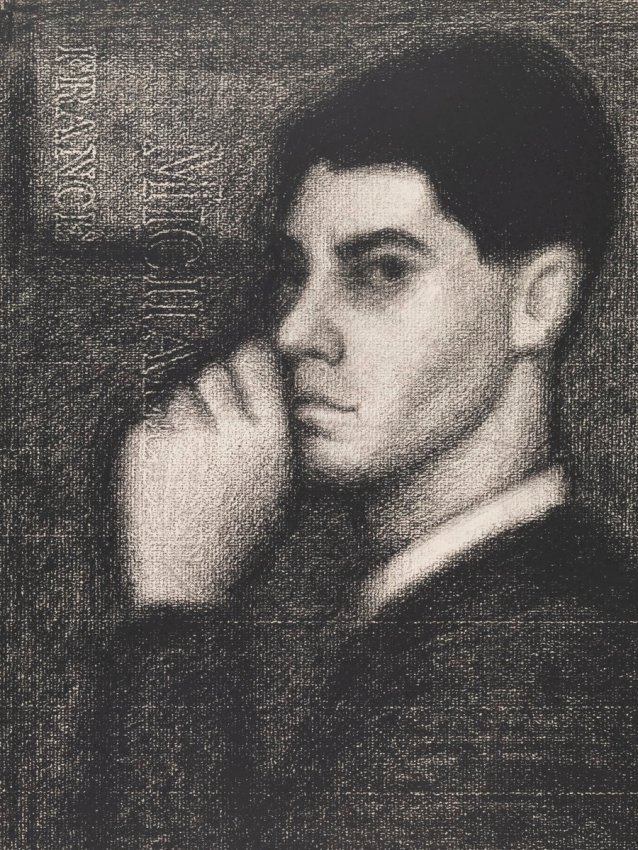
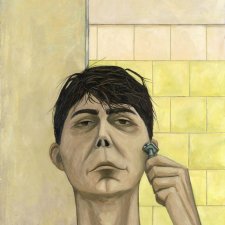
Brack also looked back through the catalogue of art history – picking up threads and pulling, seeing where they land. In this way he always sat slightly outside modern art movements as they folded into each other in postwar Australia. Alongside van Gogh, François Boucher and Edouard Manet, as a young artist Brack looked to post-impressionist artist Georges Seurat. Preceding the linear tightness of Brack’s later drawings, in both form and materiality, his Self portrait (c. 1948) responds to Seurat’s delicate, yet almost sculptural studies for Une baignade, Asnières (Bathers at Asnières) (1884).

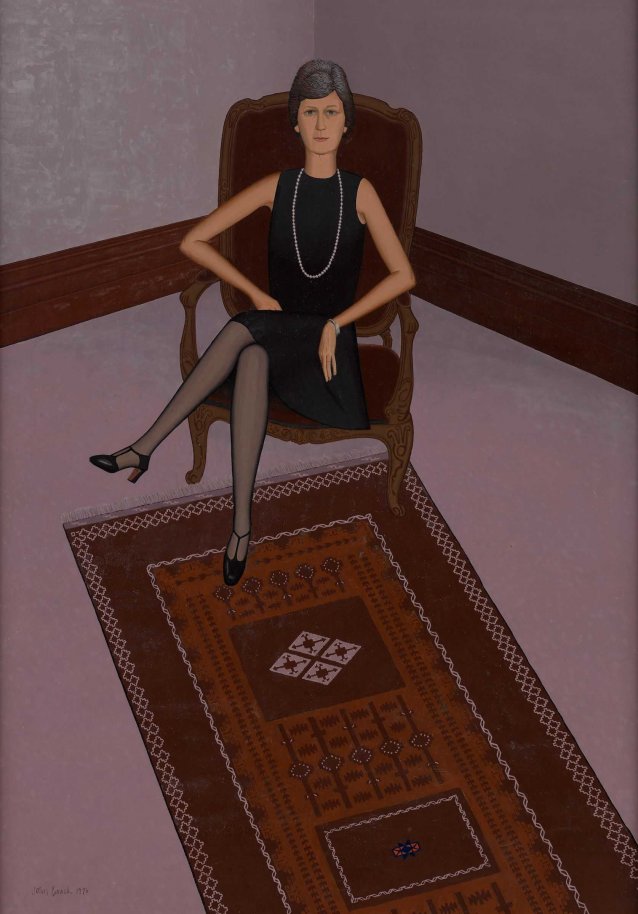
This self portrait carries emotional intensity at close range. Brack’s other portraits are also close studies of emotion – even if we might not immediately read it into the austere, sparse compositions. In many instances, this emotion is spatially defined. Rooms appear to tip forward, the ground careens towards us with the diagonal thrust of Persian carpets across the foreground. Brack often tracks perspectival vanishing points through the wooden skirting, placing his subject at its apex, as in his finely observed 1976 portrait of physician and radiologist Joan Croll.

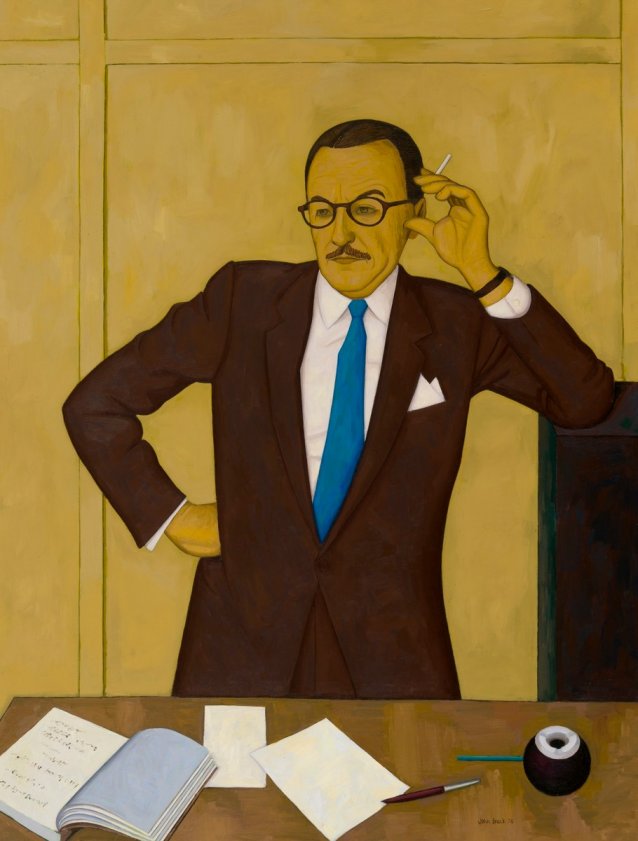
While working with form that tends towards the angular, neither Brack nor McKenna have ever been particularly persuaded by the rules of geometry. The tilting and tightening of spaces, a signature for both artists, suggests something of the human condition and the ways in which a subject navigates the world around them. In this placement, or displacement, we see the complex relationship between the artist, sitter and audience, rather than a laboured dedication to realism. As Brack’s widow, artist Helen Brack (née Maudsley), explained, ‘In John’s view, mere likenesses were not portraits; a portrait was about identity, the disposition – not the persona – and the whole picture was the portrait, the configuration in the rectangle and use of picture space.’ She said of Portrait of Tam Purves (1958), for example: ‘here is an essay about a businessman, and John makes no concessions.’ Thomas ‘Tam’ and Anne Purves founded the Australian Galleries in Collingwood, Melbourne in 1956. Brack began exhibiting with them the following year, alongside artists such as Arthur Boyd, Sidney Nolan and Albert Tucker. In this portrait Tam stands hand on hip with a cigarette held aloft, his gaze downturned in steady contemplation. Before him are the props of the gallerist: carbon paper receipt book, assorted pens and slips of paper, ashtray.

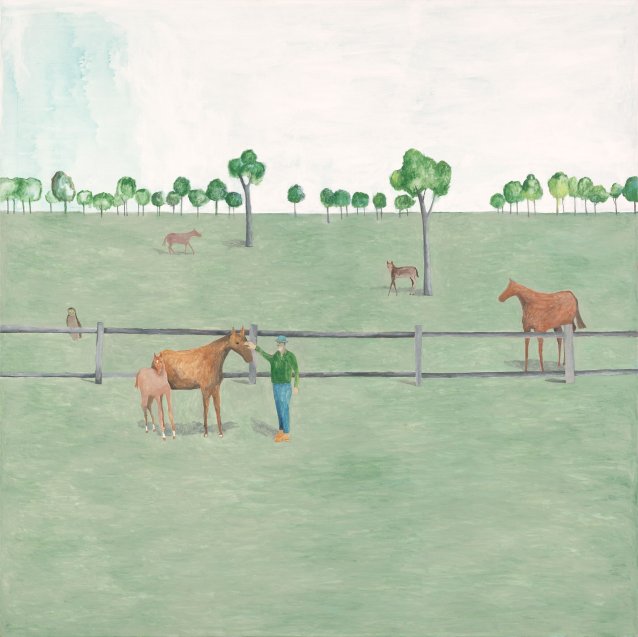
In McKenna’s portrait of his longtime gallerist, William Nuttall with horses in field (2023), the broadly painted green paddock locates the subject away from his expected habitat within the white walls of the commercial art gallery, and situates him instead in a paddock with his beloved equine companions. William ‘Bill’ Nuttall is the Director of Niagara Galleries in Melbourne, which he established in 1978 at the age of 22. In the painting we recognise the ease and mutual respect in the exchange between Nuttall and the mare, a portrayal both intimate and introspective. Animals frequently occupy McKenna’s canvases. In an interview with New York gallerist François Ghebaly, McKenna explained: ‘As an introverted child I found much solace and comfort in my pets, and still do to this day ... I try to give my subjects an important presence in my paintings, one that appreciates the complexity and wonder of animals.’

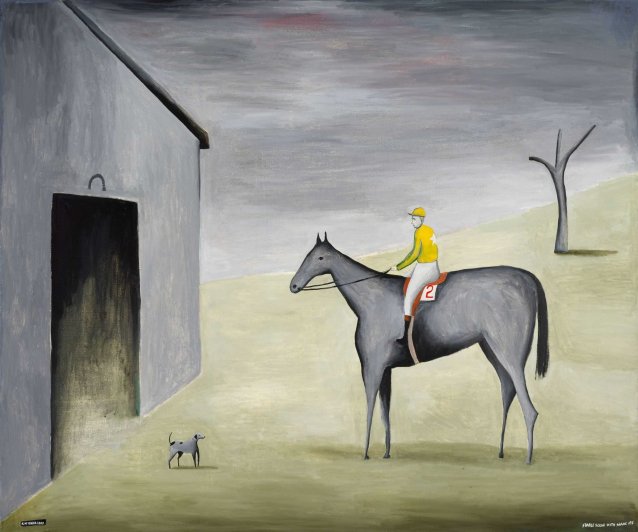
Horses, in particular, have been central to McKenna’s artmaking for much of his career, inspired by trips to the races with his father, Jim. ‘I made a few paintings and etchings inspired by the racetrack my father used to take me to when I was around 15,’ McKenna says. ‘As I became more interested in Brack’s earlier works, the racetrack series was a favourite.’ With a nod to the leggy steeds that feature in Brack’s 1956 racecourse series (and noted in McKenna’s crossword), McKenna’s horses have an endearing awkwardness and solidity to them. Brack’s interest in the spectacle of horseracing was influenced by the trackside impressions of Edgar Degas and Henri de Toulouse-Lautrec. But Brack’s experience of Melbourne’s Flemington Racecourse on wintry Saturday afternoons was not as fond nor exuberant as that of his artistic forefathers. In 1957 he recalled, ‘I was scarcely prepared for the almost total absence of gaiety. Artists in the 19th century … dealt with horseracing in a more or less festive spirit. It seems to have little or no relation to the solemn ritual which ruled Melbourne racecourses.’ In Stable scene with Shane Dye (2000), we see McKenna’s own enduring fascination with the various characters of the racetrack. And yet, like Brack, it is not the dynamism of that world he captures, but the quiet, often unassuming, moments we might otherwise only glance in our periphery.

The way both McKenna and Brack capture the world of the racetrack typifies not only their observational acuity but the way they channel emotional nuance into the dry and deadpan. No subject is ever one dimensional – regardless of their penchant for flattened form. For both artists, a picture of a jockey or a horse isn’t just a mute narrative scene but is laden with the weight of the entire horseracing industry’s history: the loss, the hope, wealth, the grit and the grim. Never shallow nor glib, both artists turn the everyday into a complex psychological study. When we think about lineage and artistic affinity, it is this shared sensibility – more than context and the cultural moment – that reaches out and binds these two artists.

© National Portrait Gallery 2026
King Edward Terrace, Parkes
Canberra, ACT 2600, Australia

Phone +61 2 6102 7000
ABN: 54 74 277 1196

The National Portrait Gallery acknowledges the Traditional Custodians of Country throughout Australia and recognises the continuing connection to lands, waters and communities. We pay our respect to Aboriginal and Torres Strait Islander cultures and to Elders past and present. We respectfully advise that this site includes works by, images of, names of, voices of and references to deceased people.

This website comprises and contains copyrighted materials and works. Copyright in all materials and/or works comprising or contained within this website remains with the National Portrait Gallery and other copyright owners as specified.

The National Portrait Gallery respects the artistic and intellectual property rights of others. The use of images of works of art reproduced on this website and all other content may be restricted under the Australian Copyright Act 1968 (Cth). Requests for a reproduction of a work of art or other content can be made through a Reproduction request. For further information please contact NPG Copyright.

The National Portrait Gallery is an Australian Government Agency