Menu

The National Portrait Gallery acknowledges the Traditional Custodians of Country throughout Australia and recognises the continuing connection to lands, waters and communities. We pay our respect to Aboriginal and Torres Strait Islander cultures and to Elders both past and present.

Aboriginal and Torres Strait Islander viewers are warned that this website contains images of deceased persons.

In profile

by Serena Bentley, 2 December 2025

Seeking affirmation of a mother, 2025 Scotty So. © Scotty So, courtesy of MARS Gallery

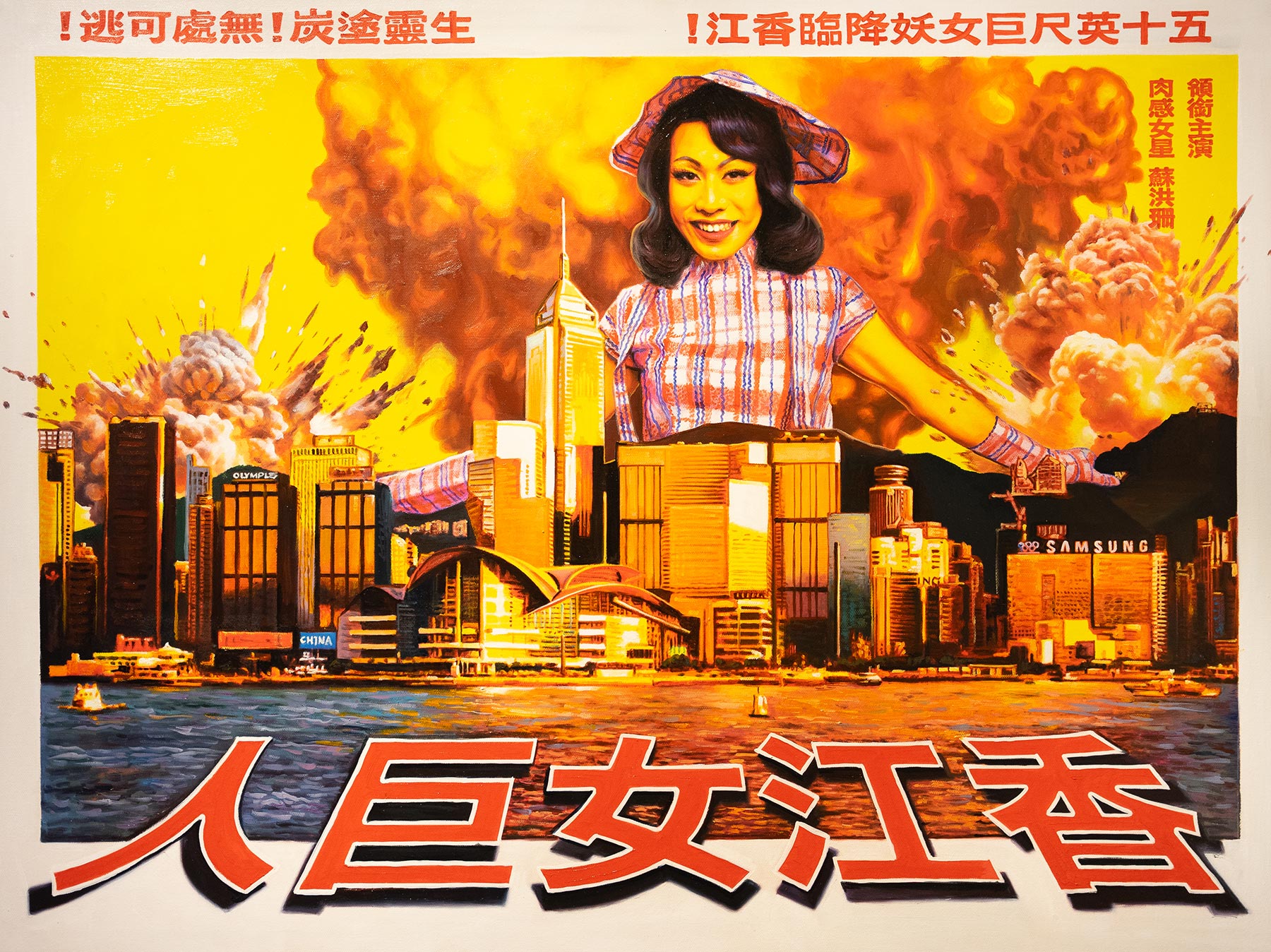
Who is Scotty So? The Naarm/Melbourne-based artist dons personas like clothes – the screen siren, the secretary, the spy. So consistently places himself centre stage, using self portraiture as a tool to examine the slipperiness of identity, an area of abiding intrigue for the artist. His creative approach is layered through the lens of personal experience, particularly within the context of his Chinese and Thai heritage, and mines references from fashion, queer and popular culture. This fusion of influences informs the way So humorously draws attention to, and upends, various cultural tropes.

In 2018 So left his birthplace of Hong Kong for political reasons, migrating to Melbourne to finish the final year of his Bachelor of Arts at RMIT before enrolling in a Bachelor of Fine Arts (Honours) in Visual Art at the Victorian College of the Arts (VCA). Isolated from his family and friends, much of his work at this time focused on otherness and the visual language of loneliness on the internet. His sculpture Narcissus Found His Echo 2018, for instance, featured an iPhone streaming a Facebook Live suspended above a mirror, suggesting an eternal and unrequited echo.

As his visual arts practice expanded in Australia to encompass photography, installation, video and performance, so too did his thematic interests. ‘There are a lot of references to day-to-day objects, pop culture, sex and gender, cultural identity, history and Eurocentric exoticism,’ he says. ‘I like to mix different things together and challenge the western art perspective.’

It was during his study that So’s passion for drag blossomed, a discipline that remains deeply embedded in his practice. ‘My first intuition was to do the looks of Asian women in the 1920s to 1960s,’ he explains. ‘I have always been obsessed with the music and style from 1930s–40s Shanghai and 1950s–60s Hong Kong, so I drew a lot of my inspiration from that. I like the referential quality in drag and how it challenges the authority of authenticity through performing genders and different cultures’.

Since graduating, So has created numerous female characters including his drag alter-ego, Scarlett So Hung Son, inspired by his Hong Kong and Thai grandmothers. In a 2020 interview with the VCA’s Mireille Stahle So described Scarlett as ‘the symbol of an Oriental silhouette. She’s the drag persona that allows me to become the beauty that I always wanted to see. And when I look at myself in the mirror, I see the woman who I wanted to become’.

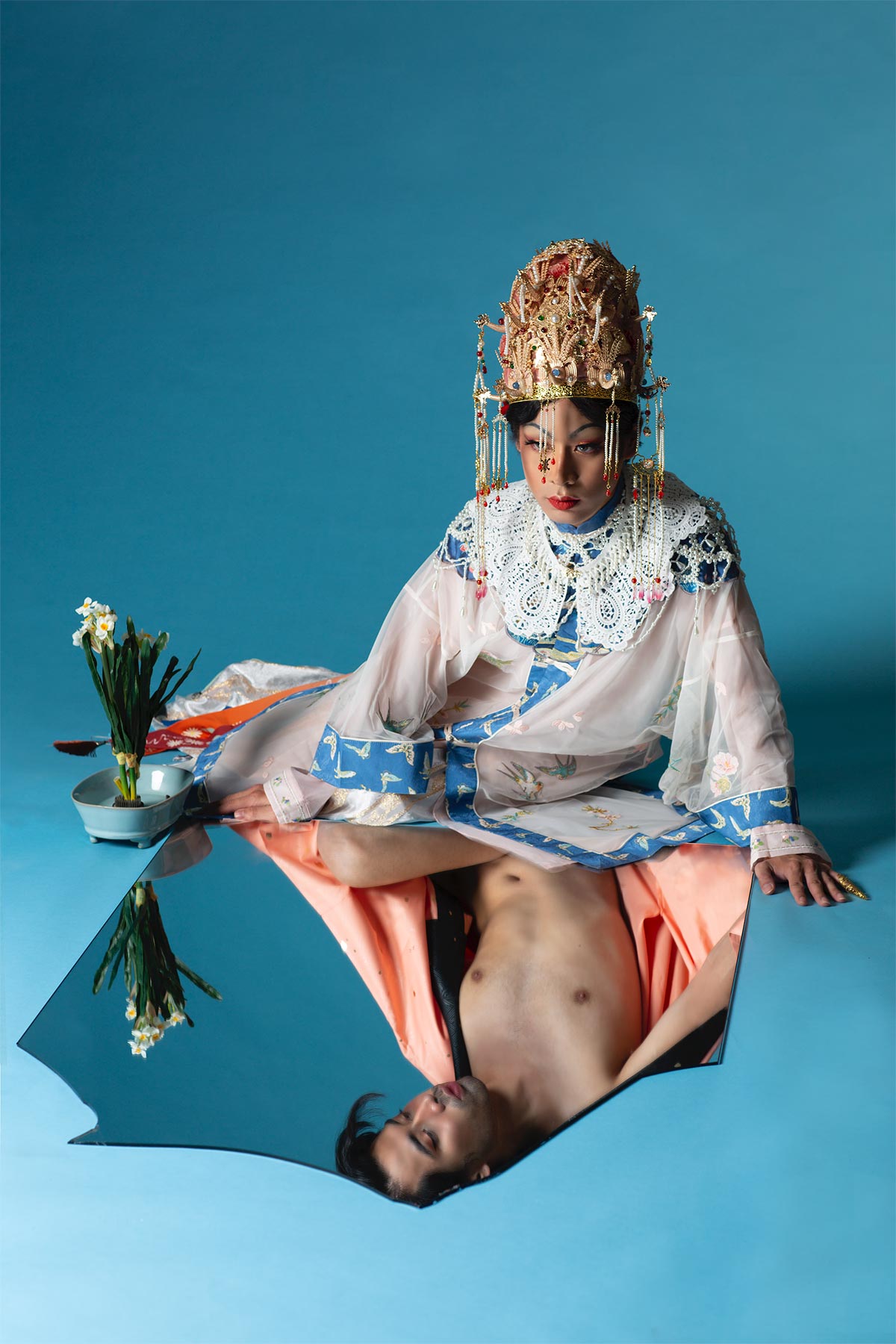
1 Reflection, 01, 2022 Scotty So . Commissioned for PHOTO 2022. 2 Scotty So performing As she floats at the Performing Textiles opening at the Ian Potter Museum of Art , 2019. Photo: Greg Lorenzutti, courtesy Ian Potter Museum of Art, University of Melbourne.

The exaggerated female forms of drag permit So to delve further into the performative nature of identity. ‘The more I perform as different characters, the more I explore who I am as an artist and a person,’ he said in a 2022 Harper’s Bazaar interview with Alexia Petsinis. With no formal training in fashion and textiles, So used the VCA costume department to create his own costumes for his work, which at the time spanned from free-range performances such as silently lip syncing to his AirPods in traditional Chinese opera costume at the Ian Potter Gallery (in As she floats 2019) through to highly orchestrated studio shoots. Each costume reflected a different incarnation of the artist, their physicality influencing the way So felt and performed. So’s outfits often reflect his dual interest in high fashion (notably Alexander McQueen) as well as what he refers to as ‘cultural clothing’. ‘I started exploring the elegance and glamour present in other styles of clothing I could access,’ he explained in 2022, ‘garments that were familiar to me like kimonos and the traditional Chinese cheongsam.’

1 Channei, 2021 from the Hai KotTou series. Scotty So. 2 Guchi, 2021 from the Hai KotTou series. Scotty So. Both Courtesy of the artist and MARS Gallery © Scotty So

So’s ‘Guchi’ models, seen in his 2021 photographic series Hai KotTou, are one such example. Drawing on fashion advertising campaigns, the series features a glamorous So in form-fitting monogrammed cheongsams, complete with accompanying tongue-in-cheek titles like ‘Lou Waitang’, ‘Fenli’ and ‘Channei’ that allude to the trade of fake luxury goods. Hai KotTou is a homage to the artist’s Hong Kong grandmother, who often wore her fake Burberry scarf to the local wet market. So photographs himself tugging a monogrammed shopping trolley through areas of Melbourne with high migrant populations, such as Preston Market. In doing so, the artist explores the often-contradictory relationship between humour and sincerity and how the commodification of cultural symbols can inform identity. ‘If I’m in drag looking fabulous wearing fake Louis Vuitton, does it matter if what I’m wearing is fake or real?’ he said in 2022. ‘After all, I’m not a real woman either. I think I’m creating an illusion, and that’s what matters.’

1 China Girl Assistant of the China Magician Performing Levitation Act, 2024. From Make Believe: Encounters with Misinformation at State Library Victoria. 2 Wearing a mask at the end of the Spanish Flu, No. 1, 2020. National Gallery of Victoria, Melbourne. Purchased, Victorian Foundation for Living Australian Artists, 2021. Both Scotty So.

Illusion was central to the thinking behind the 2025 exhibition Make Believe: Encounters with Misinformation at State Library Victoria, in which four artists including So investigated how misinformation has shaped life and culture. Interrogating the authenticity of the archive, So restaged historic photographs from the library’s collection. He shapeshifted among ‘authentic’ collection objects, appearing in doctored images as a Manchurian noble lady in the 1800s, a Cantonese woman with bound feet wearing a silk mask during the bubonic plague in 1900 or a real housewife of Box Hill.

An oscillation between what is fake and what is real is channelled through the artist by proxy in Seeking affirmation of a mother (2025), recently acquired by the National Portrait Gallery. Appearing in hologram form, So has fused himself with the voice and likeness of pop-cultural figure Kris Jenner, ‘momager’ of the Jenner-Kardashian empire. Using artificial intelligence (AI) to conjure Jenner’s voice, So acts like a puppet master. The Jenner hologram in turn responds to So; the monologue she performs for us is about So himself. She alternates between two contrasting evaluations of his practice: an effusive celebration of his artistic brilliance and a biting takedown of his work as derivative and self-indulgent, all generated using the AI chatbot, chat GPT. The piece nods to a 2020 episode of The Kardashians, where Kanye West surprised Kim Kardashian with a hologram of her late father, Robert Kardashian, for her 40th birthday. In a later 2023 episode, Jenner creates a hologram of herself to surprise her daughter Khloe.

Seeking affirmation of a mother reveals a new approach for the artist, in which So combines deep, personal emotion with a high camp visage. With his signature blend of irony and humour, So pokes fun at the fragile ego of the artist and his yearning for validation, framing the work as a therapeutic exercise. As he shared with me: ‘In the end, the AI voice line, the persona of Kris Jenner, the drag representation of her and the hologram version of her, none of these are real but it contains a certain truth of a queer artist seeking truths in their practice while aimlessly seeking affirmation of others and especially from a mother figure.’

More broadly, Seeking affirmation of a mother examines how identity is negotiated in digital spaces, where self-presentation and public perception influence how we construct and curate our personas. Set against the backdrop of the deepfake era – digitally manipulated photos, video or audio files that use AI to create a realistic but false depiction of a person doing or saying something they didn’t do or say – the work is a compelling summation of So’s current concerns, employing new technologies and popular culture to examine nuanced ideas of identity and its co-option. By adopting the voice and persona of a celebrity, So pushes drag into ethically ambiguous territory, raising questions about the ownership and control of identity in the digital age. Blurring the line between fantasy and reality, So disarmingly uses campness and beauty to question the reliability of the images we consume against the backdrop of a world of rapidly advancing technologies.

Related people

Scotty So

© National Portrait Gallery 2026
King Edward Terrace, Parkes
Canberra, ACT 2600, Australia

Phone +61 2 6102 7000
ABN: 54 74 277 1196

The National Portrait Gallery acknowledges the Traditional Custodians of Country throughout Australia and recognises the continuing connection to lands, waters and communities. We pay our respect to Aboriginal and Torres Strait Islander cultures and to Elders past and present. We respectfully advise that this site includes works by, images of, names of, voices of and references to deceased people.

This website comprises and contains copyrighted materials and works. Copyright in all materials and/or works comprising or contained within this website remains with the National Portrait Gallery and other copyright owners as specified.

The National Portrait Gallery respects the artistic and intellectual property rights of others. The use of images of works of art reproduced on this website and all other content may be restricted under the Australian Copyright Act 1968 (Cth). Requests for a reproduction of a work of art or other content can be made through a Reproduction request. For further information please contact NPG Copyright.

The National Portrait Gallery is an Australian Government Agency