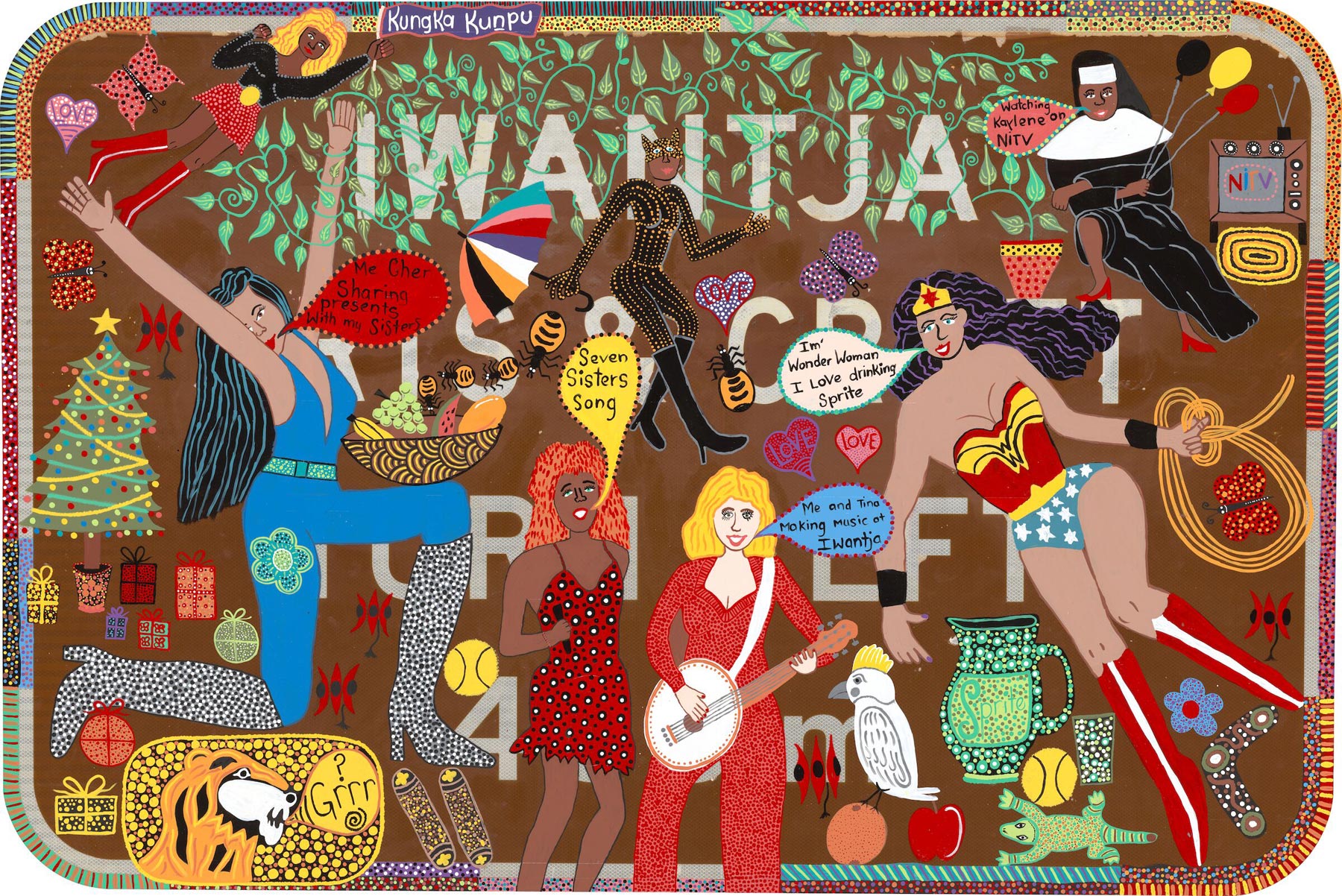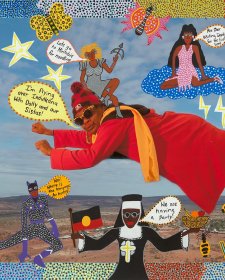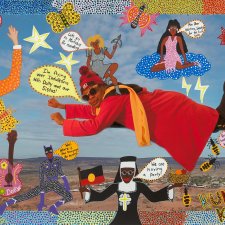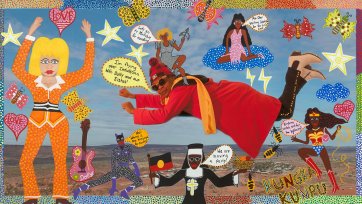

Yankunytjatjara artist Kaylene Whiskey is kungka kunpu (a strong woman) in charge of her own narrative: visible, centralised and powerful. Kaylene’s practice is an extension of who she is, the main character of her life in Indulkana, belonging to Anangu culture and proud of her identity. Her portraits of celebrities, superheroes, community and herself are self-determined visions of people and place that traverse local and global contexts.
Kaylene’s work typifies the potential of First Nations portraiture to explore identity from the perspective of lived experience. Grounded in the power of storytelling, Kaylene makes art to transform her ideas into visions and make sense of the worlds we navigate, in layered multiplicity. She serves femme champions in vibrant visual stories as reflections of her own outlook on life, while emphatically working in generosity. Kaylene’s portraits represent her, often on Country and within the contexts of her culture work, placed in unfolding moments across time. Then, she takes her locality a step further, to include the glittering world of celebrity, universal brands and a sprinkling of emoji-like symbolism for good measure. Kaylene is dancing in many worlds and invites us to join her.
Kaylene’s practice has expanded in scale and detail over time, allowing us to trace the stylistic evolution of her portraiture and subjects. We see the increasing complexity and density of her scenes – from head-and-shoulders portraits to large-scale group scenes inhabited by multiple figures, objects, animals and plants. Arguably, Kaylene’s work is a sustained engagement with portraiture, comprised of recurring characters, including the artist herself, alongside pop icons like Dolly Parton, Cher and Wonder Woman. In Kaylene’s scenes, international guest stars regularly drop by to visit her in Indulkana. Appearing alongside her co-stars, Kaylene is never eclipsed by them, so that we come to understand the artist as an A-lister sister, equal to the celebrities with whom she shares the stage.
When the curtains go up, we are transported to Kaylene’s world. Beyond the limits of likeness and into the internal universe we go – to witness everything that matters to the artist: culture, passions, hopes and dreams. This unique and personal outlook flows within Kaylene’s portraits, a mega mash-up under the broader identifiers of self: who we are, who we love, where we are, what we consume, our community, the past, the present … and how it all comes together in story.
By design, portraits are produced to capture human existence; elevating and immortalising people of importance. This assertion – I exist! – is highly political, a signifier of hierarchy and a record of who is valued within society. At Iwantja Arts Centre, Kaylene has worked alongside innovative peers who seek a fluid form of portraiture to assert their own existence, such as Vincent Namatjira, who presents his family line alongside royalty, prestige and power, and the late Kunmanara (Tiger) Yaltangki, who created a sustained series of self portraits to represent his community, music culture and mamu (spirit beings).
While Kaylene and Vincent push, resist and shape new forms for portraiture, it is imperative to note that historical representations of First Peoples are by and large determined by colonial perspectives. Within the lens of ‘other’, First Peoples have been subjects of study, aligned with unsafe anthropology practices. Kaylene’s works, on the flip side, are created with agency to reinforce visibility; a shift away from ‘other’ to a reclaiming of ‘me’. Art tools in hand, Kaylene shows and shares who she is, thriving in a world of her own making. To amplify the individual in a broader context, Kaylene asserts that ‘me’ makes sense as ‘we’, sharing currency and prioritising the collective; all-in-everyone-now. We are stronger in our togetherness. Kaylene knows this and encourages audiences to be empowered and motivated – conquering challenges, enjoying life, looking good, supporting each other and treasuring resources. As Kaylene says, ‘My art is for everyone. I want to share love, happiness, laughter and togetherness with everybody! Uwangkara tjungu, mulapa rikina! [Everyone together, looking so good!].’