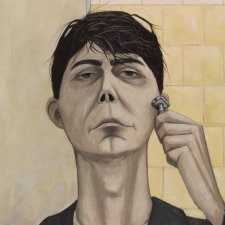
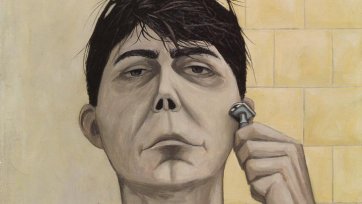
Brack began to establish himself as a realist painter of postwar urban life in the mid 1950s, his reputation cemented by the acquisition of his work The barber’s shop by the National Gallery of Victoria in 1953. Painted two years later, this self portrait is an introspective gesture from an artist beginning to gain public notoriety. Brack, then 35 years old, is dressed in striped pyjamas and a green tartan bathrobe. Against the lemon-yellow tiles of the bathroom he shared with Helen Maudsley and their four daughters, he attends to the intimate morning ritual of shaving. Sunken eyes observe the activity of his hand and razor through the reflection in the mirror. The long stretch of Brack’s neck meets his slightly upturned chin. With the same directness we see in his paintings, in 1957 Brack responded to queries from ‘a good many people’ as to why he ‘chose so inauspicious an occasion as the harsh pre-breakfast hour’ with the simple point that ‘shaving is the most obvious time to look at oneself in the mirror’.
There is a halting intimacy to the scenes that Brack sets in a bathroom. But this makes sense, for a bathroom can be a space of pronounced vulnerability. In Brack’s self portrait, painted from the perspective of the mirror, the artist holds a razor to his cheek. The lackof shaving cream or stubble makes us think he’s finished his grooming, or else the gesture is purely performative, the razor a prop and its sharpness a statement. The figure in McKenna’s bathroom mirror scene by comparison is far more lively; the cat perches on the sink mesmerised by its own reflection.
In these paintings of glimpses caught and reflected, the entanglement of the two artists finds an echo. Both have made work that contends with their own reflection, however opaque. In the other self portraits nearby, we see Brack offer only the faintest suggestion of himself in a shop window full of medical instruments while McKenna tracks his life as if it were a scientific study. Their approach to self-inquiry is furtive and circuitous – often even detached – but still frank and honest. In this way, beyond their shared fascination with particular themes or subjects, they resemble one another like a skewed mirror image.
National Gallery of Victoria, Melbourne
Purchased with the assistance of the National Gallery Women's Association, 2000